
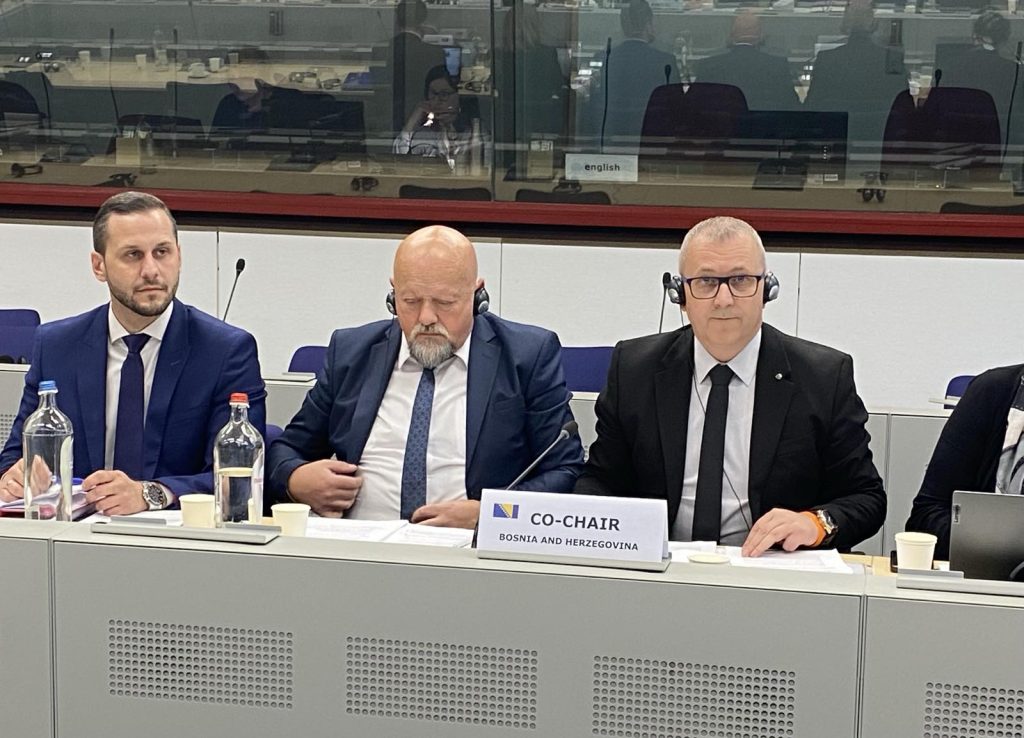
The ninth meeting of the Special Group on Public Administration Reform between the European Union and Bosnia and Herzegovina (hybrid format) is being held today in Brussels.
The first part of the meeting was marked by a high-level political dialogue on public administration reform, co-chaired by Davor Bunoza, Minister of Justice of Bosnia and Herzegovina, and Barbara Jesus-Gimeno, Head of the European Commission Unit for Montenegro and Bosnia and Herzegovina. Among other things, the priorities related to functionally managed public finances and building a professional civil service that effectively provides services to citizens were discussed at the meeting.
In the second part of the meeting, which is currently underway, a dialogue will be held at the technical level on public administration reform, co-chaired by the Public Administration Reform Coordinator Darko Kasap. The meeting will discuss, among other things, the implementation of the Action Plan for the Implementation of the Strategic Framework for Public Administration Reform in BiH, as well as civil service, accountability and human resource management.
In a statement to the press, the Public Administration Reform Coordinator said that they would inform the European Commission that the public administration reform in Bosnia and Herzegovina is at a certain stalemate.
“The Revised Action Plan for the continuation of the implementation of the reform has not yet been adopted by the Council of Ministers of Bosnia and Herzegovina, as it is awaiting adoption at all other levels of government. The plan envisages that the institutions implement most of the approximately 150 activities contained in this document in five areas of administration in Bosnia and Herzegovina, during this and next year, when the Revised Action Plan expires. Therefore, there is less and less time to comply with the set time frames,” he warned.
The Public Administration Reform Coordinator pointed out that “the reform is not progressing according to the dynamics envisaged by our documents, which is also evident from our latest progress report for 2025, which is still in the proposal phase and has not yet been adopted.”
“By the end of last year, only 17.66% of the activities from the Action Plan had been fully implemented, partially 7.06%, and there were almost no changes compared to 2024. Funds in the Public Administration Reform Fund are still blocked, with the unblocking being discussed after the Revised Action Plan has been sent to all governments. In the past period, an agreement was reached to send the Revised Action Plan to the governments first. It is about BAM 10.5 million that should be used to finance the reform,” said the coordinator.
He added that this is only a small part of the funds needed for the implementation of the Revised Action Plan, the total value of which is about BAM 70 million.
“We also discussed this with the European Commission today. Bosnia and Herzegovina is asked to provide financial support to the work of the Fund by the local authorities at all levels, and the European Commission encourages us to reach out to donors in order to ensure sufficient funds for the implementation of all activities.”
The Public Administration Reform Coordinator emphasized that “the recommendations we received last year from the European Commission have largely not been implemented and are being repeated this year.”
“It is necessary to adopt the Revised Action Plan and start its implementation by mid-year at the latest, as well as to harmonize the laws on civil service with the principles of merit, which means that employment, promotion and human resources management should be based on merit, expertise, abilities and achieved results. Among other things, the recommendations refer to the need to create and regularly update a publicly available register of state-owned enterprises in both entities, implement the recommendations of the Human Rights Ombudsman, improve sectoral planning at the level of the whole country, and improve the right of access to information by amending laws in the entities and further improving the laws of Bosnia and Herzegovina and Brčko District. We are also expected to make progress in the field of digitalization,” Kasap pointed out.
In the end, he added that the citizens of Bosnia and Herzegovina and the business community suffer the most due to the non-fulfillment of reform obligations, because so far we have not been able to establish an administration that is fully transparent and open, rational and responsible in the management of public financial and material resources, and an administration that works faster and provides cheaper services.
The European Union is expected to reiterate the recommendations it has already made to Bosnia and Herzegovina.